For six months in 1969, one of the two cascades that make up Niagara Falls simply stopped flowing. Engineers had shut off the water on purpose, turning a thundering wall of whitewater into a bare, silent cliff of exposed rock. What they found underneath surprised almost everyone, including the people who had planned the project in the first place.

The moment is still talked about today because it is one of the few times in modern history that a major natural wonder was, in effect, switched off and inspected up close. The site of that project — the American Falls, one of the three cascades at Niagara — went from a churning torrent to a dry, rocky slope that visitors could walk right up to and touch.
Why Engineers Would Even Attempt This
Niagara Falls is actually made up of three separate waterfalls: the Horseshoe Falls, the Bridal Veil Falls, and the American Falls. The American Falls carries far less water than the Horseshoe Falls, which made it the only realistic candidate for a temporary shutdown.
By the late 1960s, officials had grown concerned about the buildup of rock debris at the base of the American Falls. Erosion and rockfall had left large piles of talus — broken stone — piling up at the bottom, and there was a fear that the falls could eventually become clogged or altered in ways that would change its appearance permanently. The U.S. Army Corps of Engineers decided the only way to properly study the situation was to see the riverbed with no water running over it at all.
Building a Temporary Dam
To pull this off, crews constructed a temporary rock and earth dam across the Niagara River at the head of the American Falls, redirecting the water so that it flowed instead over the Horseshoe Falls on the Canadian side. This meant the Horseshoe Falls had to carry a heavier load of water during the project, while the American Falls side went almost completely dry.
The dewatering was not an accident or an emergency measure. It was a carefully engineered, deliberate act meant to give researchers and engineers a rare chance to study the bedrock, the erosion patterns, and the structural stability of the falls without a wall of water in the way.
What the Exposed Riverbed Actually Looked Like
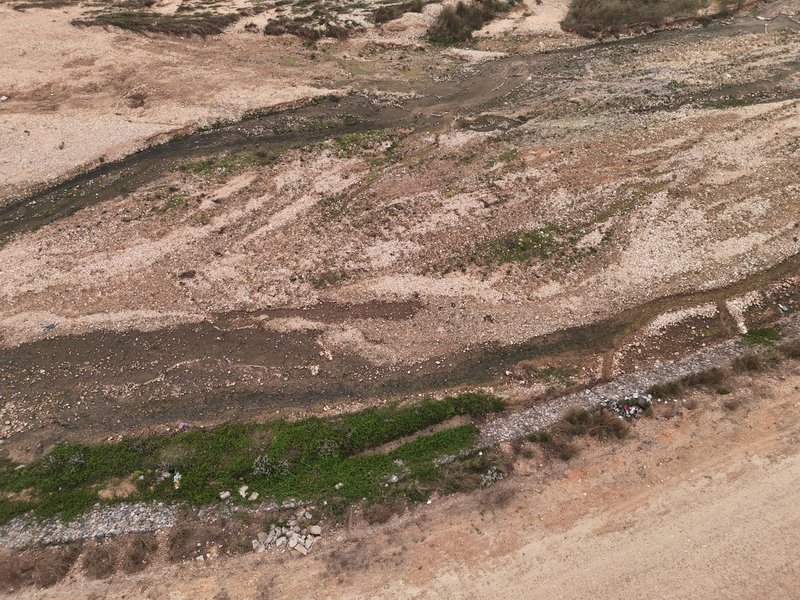
With the water gone, the American Falls looked almost unrecognizable. Instead of a sheer sheet of falling water, visitors and engineers saw a steep, jagged slope covered in broken rock, boulders, and debris that had built up over an enormous stretch of time. The riverbed itself was littered with loose stone, and the cliff face showed clear signs of the layered rock structure that makes up the Niagara Escarpment.
The dry falls drew huge crowds. People came from all over to see something that had never been witnessed by the general public before: a Niagara Falls dewatered from the top down, with only a trickle of residual water left running through the exposed channel.
Surprising Discoveries in the Rock
Once engineers and geologists could examine the bedrock directly, they found conditions that were more complicated than expected. The rock beneath the falls was more heavily fractured than models had suggested, with joints and cracks running through the stone in ways that raised concerns about long-term stability.
Some of the notable findings included:
- Large accumulations of talus (broken rock debris) at the base, confirming ongoing erosion concerns
- Fractured and jointed bedrock that suggested the cliff face was more fragile than assumed
- Evidence of the layered rock structure, with softer stone beneath harder caprock, a pattern that drives erosion at waterfalls generally
- Signs that water and ice had been working their way into cracks in the rock over long periods, gradually loosening sections of stone
These discoveries mattered because they helped engineers understand exactly how the falls were eroding and what might need to be done, if anything, to manage that erosion in the future.
Human Discoveries: What Turned Up in the Riverbed
Beyond the geology, the dewatering also turned the riverbed into an accidental time capsule of human history. Once the water stopped flowing, crews and visitors found personal items that had been swept over the falls or lost in the river over the decades. Coins, various pieces of debris, and other objects that had settled into the rocky riverbed for years were suddenly visible in the open air.
Perhaps the most sobering discoveries were human remains. Given how many people over the years had gone over the falls, whether by accident or intentionally, it was not entirely surprising that when the water stopped, some remains were recovered from the riverbed. It was a stark, quiet reminder of the falls’ long and sometimes tragic history, hidden beneath the surface of one of the most photographed natural landmarks in North America.
A Rare Look at Erosion in Action
One of the lasting contributions of the project was the improved understanding of how Niagara Falls has moved and changed shape over thousands of years. Waterfalls like Niagara are not static features; they erode upstream over time as the force of the water wears away softer rock beneath a harder caprock layer, eventually causing the caprock to collapse and the falls to retreat.
By studying the American Falls directly, engineers gathered valuable data on how this erosion process was unfolding in real time, which helped inform decisions about the future management of the site.
What Happened After the Study
After months of study, engineers ultimately decided against a large-scale removal of the talus at the base of the American Falls. Instead, officials determined that the natural rock pile actually helped protect the base of the falls from further erosion, acting almost like a buffer. Once the assessment was complete, the temporary dam was removed, and the Niagara River was allowed to flow back over the American Falls, restoring it to its familiar roaring state.
The decision reflected a broader lesson: sometimes the most effective way to protect a natural landmark is to leave it alone rather than intervene aggressively. The debris that had worried officials in the first place turned out to be part of a natural system that was, in its own way, stabilizing the falls rather than threatening them.
Why This Moment Still Fascinates People
Decades later, the image of a dry Niagara Falls remains striking precisely because it is so rare. Most people who visit Niagara Falls today have only ever seen it as a continuous, powerful flow of water. The idea that engineers once turned that flow off entirely, exposing centuries of rock, debris, and history, still captures the imagination of anyone who hears about it for the first time.
It also serves as a reminder that even the most iconic natural landmarks are dynamic systems, shaped by slow-moving forces of erosion, gravity, and time, rather than fixed, unchanging monuments.
Conclusion
The dewatering of the American Falls in 1969 stands as one of the more unusual chapters in Niagara Falls’ long history. What began as a practical engineering study turned into a rare public spectacle and an unexpected journey into the falls’ geological and human past. The rock formations, erosion patterns, and objects uncovered during those months gave researchers a deeper understanding of how the falls have changed over time, while also reminding the public that beneath the roar and the mist lies a landscape that is constantly, quietly shifting.